
 Appediet
Rice, Noodles, or Bread? Compare the Portions You Eat
Compare rice, noodles, and bread by the portion you actually eat: match cooked state, convert household measures to grams, and keep uncertainty visible.
Start with the food you actually ate, not a universal “carb portion.” Match rice and noodles to their cooked state, use the gram weight on a bread label when available, and then put each amount on the same reference only for the question you are trying to answer.
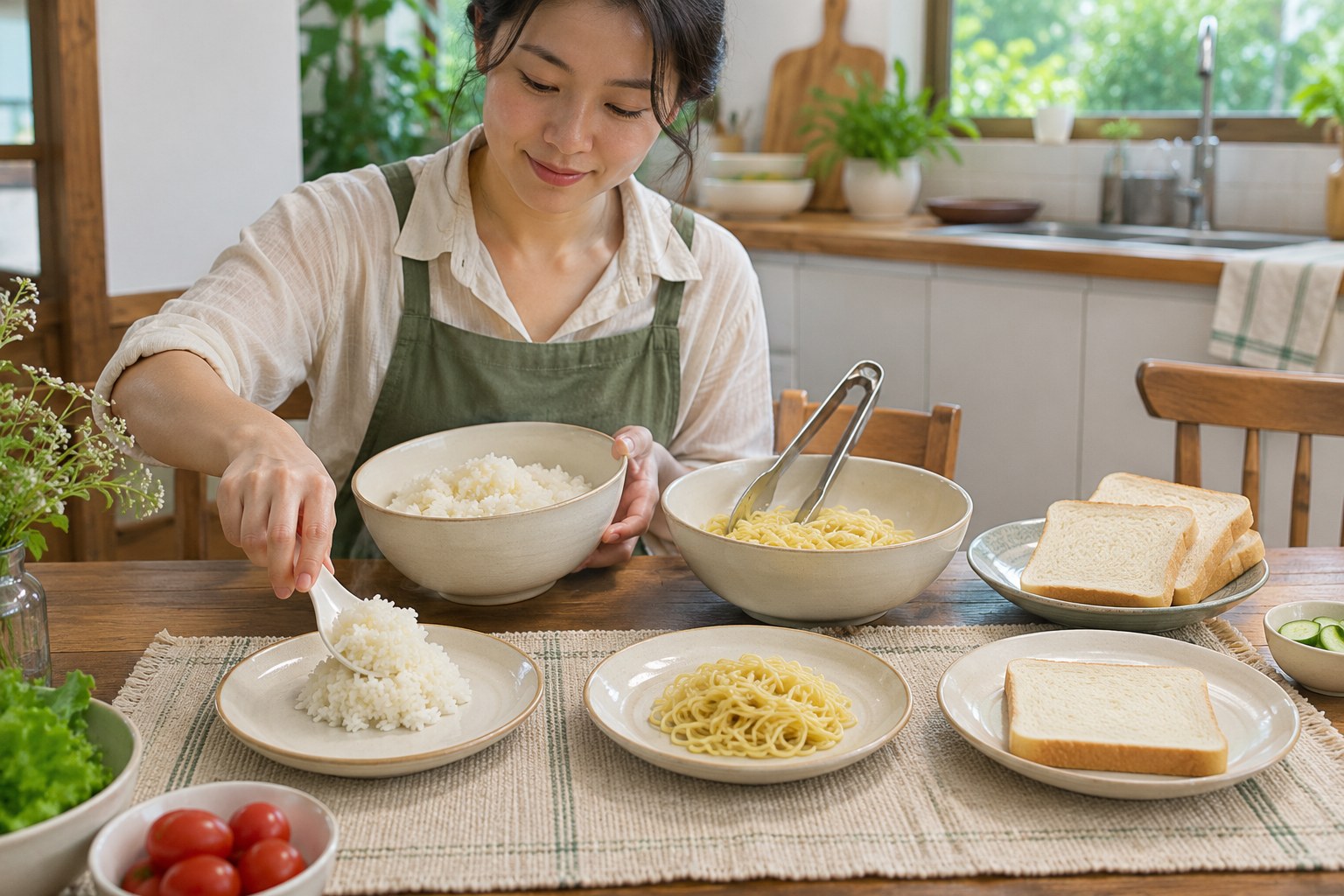
Choose the comparison you need
“How much did I eat?” and “How do these foods compare?” are not the same question. For a meal record, your actual portion comes first. For a product-label check, the package serving and its gram weight come first. For a database comparison, a common reference such as 100 grams can help—but it is a calculation tool, not a portion recommendation.
To record a meal
Measure or describe what reached your plate, including second helpings. Use the matching cooked, dry, toasted, or packaged entry.
To compare foods
Use the same reference basis and state what it is. Do not compare one cup of a cooked food with 100 grams of another and call the result equivalent.
FDA explains that a Nutrition Facts serving size reflects the amount people typically consume; it is not a recommendation for how much you should eat. That is why your portion may be smaller or larger than the label serving.
Source: FDA serving-size guidance.
Match the food and prepared state before comparing
Water changes the weight and volume of cooked rice and noodles. Bread is usually counted by slices, but slice sizes vary by loaf and brand. A food name without its state is therefore not enough for a reliable match.
The three USDA records below are examples with explicit IDs. They are not a ranking and they do not represent every type of rice, noodle, or bread. Their household measures help show why the record description matters.
| Food record | State in the record | Listed household portion | Use it carefully |
|---|---|---|---|
| White long-grain rice · FDC 168878 | Enriched, cooked | 1 cup = 158 g | Use only when the rice you measured is cooked and the description is a reasonable match |
| Egg noodles · FDC 169732 | Enriched, cooked | 1 cup = 160 g | Do not substitute a dry-noodle record for cooked noodles |
| White bread · FDC 174924 | Commercially prepared | 1 regular slice = 29 g | The same record lists multiple slice sizes; your package label can be more specific to your loaf |
Those cup weights happen to be close in these two records. That does not prove that rice and noodles have the same nutrients, the same effect on hunger, or the same usual portion for you. It only describes the listed household measure for these exact records.
Records checked through USDA FoodData Central on November 18, 2026: FDC 168878, FDC 169732, and FDC 174924.
Put each amount on a clear reference
If you know the weight you ate, you can express it as a share of a database household portion:
For example, if your cooked rice weighs 126 grams and you intentionally use FDC 168878, the calculation is 126 ÷ 158 = 0.80 of that record's listed cup. This is a math example, not a suggested rice amount and not evidence that your bowl, recipe, or cooking method is identical to the database record.
Use the same method for cooked noodles only after choosing a cooked-noodle entry. For bread, your own package label can provide a slice count and gram weight. If two slices from your loaf weigh 54 grams, do not force them into a generic two-slice assumption; use the label or actual grams and keep the product description with the record.
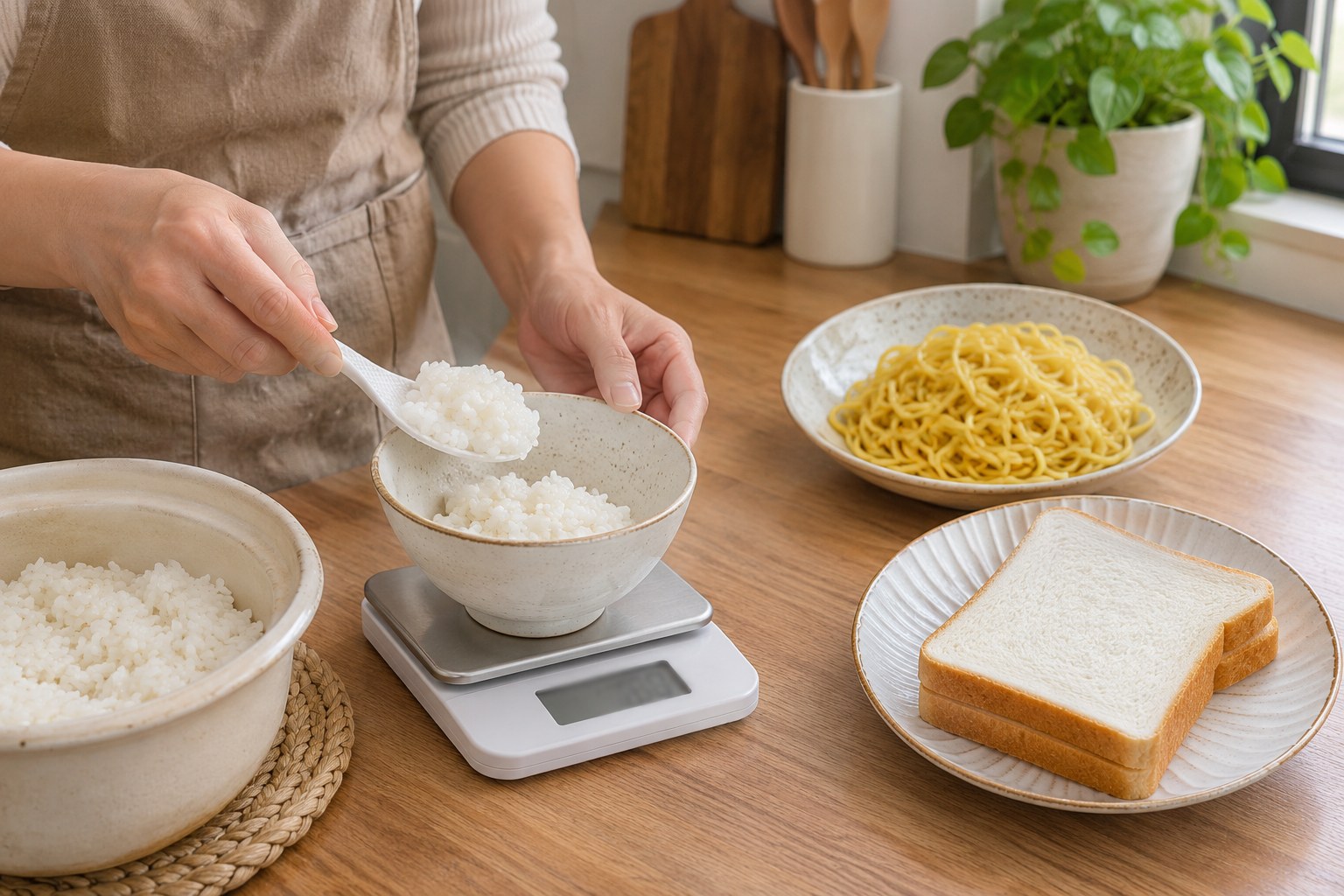
When your goal is a nutrient comparison rather than a meal log, you may convert all three records to the same mass, such as 100 grams. Say explicitly that you are comparing database values per 100 grams. Do not present that reference as what someone should eat.
Use a portion worksheet that keeps assumptions visible
| Write this down | Rice example | Noodle example | Bread example |
|---|---|---|---|
| Exact food | White long-grain rice | Egg noodles | White sandwich bread from your package |
| State | Cooked | Cooked | As sold or toasted, matching the record you use |
| Amount you ate | Grams or a measured cup estimate | Grams or a measured cup estimate | Slices plus label grams, when available |
| Source | FDC ID or package label | FDC ID or package label | Package label first when it matches your loaf |
| Uncertainty | Rice type, water, oil, mixed ingredients | Type, sauce, oil, cooking state | Slice size, recipe, toppings |
Mixed dishes need another step. Fried rice, noodle soups, sandwiches, sauces, spreads, fillings, and cooking fats are not captured by the plain staple record. Add known components separately or choose a mixed-dish record that actually matches. When neither is possible, keep the estimate broad rather than inventing detail.
Log what you know—and leave room for what you do not
If you use Appediet or another food log, choose an entry whose description and preparation state match your food. Enter the amount you ate using the units you can support. A photo can help you remember the meal, but it cannot reveal the dry weight, absorbed water, oil, sauce, or exact slice grams.
No scale is required for every meal. A measured cup, the package serving, a slice count, or a repeatable household bowl can be useful when you label the method consistently. The goal is a record you can understand later, not a false claim of laboratory precision.
Do not use this worksheet to force every staple into an identical portion. Appetite, meals, culture, food access, health conditions, and care plans differ. If measuring food increases anxiety or you have an eating-disorder history, skip the detailed tracking and seek support from a qualified professional.
Questions you may have
Is one cup of rice the same portion as one cup of noodles?
Not automatically. In the specific USDA records used here, a cup of cooked rice and a cup of cooked egg noodles have similar listed gram weights, but they are different foods and the records do not make them nutritionally interchangeable. Match the exact food and prepared state before using any value.
Can I compare 100 grams of each food?
You can use 100 grams as a common reference when you want to compare database values. That does not mean 100 grams is your usual portion, a recommended portion, or equally filling across foods. For a meal record, start with the amount you actually ate.
Do I need a kitchen scale every time?
No. A scale is one option. You can also use the package label, a measured cup, a slice count with the label's gram weight, or a consistent household description. Mark an estimate as an estimate, and follow an individual care plan if you have one.