
 Appediet
Weighed Your Rice Cooked? Match the Food Entry First
Keep dry and cooked rice weights separate, allocate a batch to your serving, and check meat, added oil, and leftovers without a universal conversion factor.
If the rice on your scale is cooked, pair that weight with a cooked-rice record. If you start with the dry ingredients for a whole batch, allocate that batch to the portion you eat. Mixing the two approaches is where an otherwise careful log can go wrong.

Match the state before the number
A gram describes mass, but it does not describe preparation. Dry rice and rice cooked in water have different amounts of water in each gram. A rice weight is only useful when the food description and the stage of preparation match it.
Read the full record name: rice type, dry or cooked state, preparation method, and any additions. Then check whether the amount is expressed per gram, per 100 grams, or per household serving. A familiar name at the top of the search results does not settle those questions.
USDA FoodData Central documents several data types with different origins. Use its record descriptions as information to inspect, not as a reason to assume every app record has identical values. A packaged product also needs the serving basis on its own label.
| What you have | What to match | What to check |
|---|---|---|
| Dry rice weighed before cooking | Dry ingredient record | Allocate the finished batch; do not enter cooked grams as dry grams. |
| Plain rice weighed after cooking | Cooked rice record | Check that oil, butter or other additions are not silently included. |
| Rice mixed with vegetables and sauce | Ingredient batch or matching mixed-dish record | Plain cooked rice alone does not describe the whole dish. |
Make the rice easy to trace
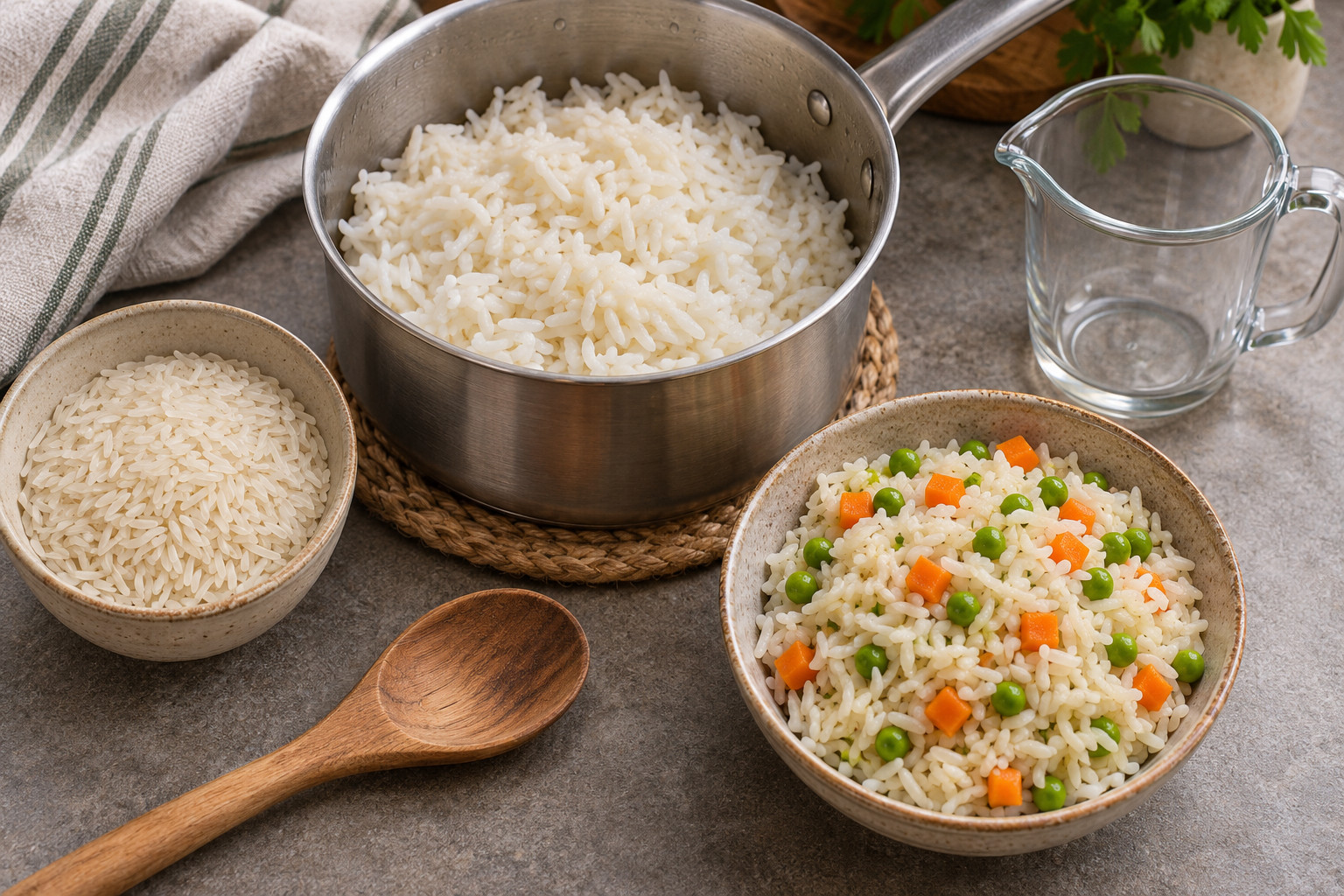
For a simple peas-and-carrot rice, keep the rice, vegetables and any cooking oil identifiable before mixing. Cook the rice using the instructions for your actual variety. Cook the diced carrot and peas until tender, then combine them with the rice. Add seasoning to taste and note any oil used for either component.
You can track the plain rice as a batch and add the vegetables separately, or make a single ingredient worksheet for the mixed dish. Choose one method for this batch. Do not log both the full mixed dish and all of its ingredients for the same serving.
If you weigh the finished mixture, include only edible food. Subtract the container weight or use the tare function. Do not use a pot-and-food reading as the finished food weight. Keep rice that will be stored in clean containers and refrigerate promptly; a weighing task is not a reason to leave cooked food out.
A batch-share example, not a cooking ratio
Suppose a plain batch begins with 200 g dry rice and, after cooking, the edible rice weighs 600 g. A 150 g cooked portion is 150 ÷ 600 = 0.25 of that particular batch. In an ingredient-based worksheet, it therefore receives one quarter of the dry-rice ingredient amount: 50 g dry-rice equivalent.
Those numbers are an arithmetic example, not a measured recipe or a claim that rice always triples in weight. Use the actual finished weight of your batch. If you have already selected a cooked-rice record and entered 150 g, do not also add the 50 g dry equivalent.
The allocation assumes the batch is reasonably uniform. After adding peas, carrot or oil, weigh and allocate the resulting dish consistently, or keep those ingredients separate. A serving with mostly rice and another with mostly vegetables will not have the same ingredient shares just because their total weights match.
Do not carry a rice shortcut over to every food
Meat can lose water and fat during cooking; drained liquid, discarded skin and bones also change what remains edible. A before-and-after weight alone does not tell you how every nutrient was retained. Match a cooked meat record to the cooking method instead of borrowing the rice example as a universal rule.
For noodles, drained canned foods and frozen ingredients, check what the label or record actually describes. Drained grams, prepared grams and grams taken directly from a package can represent different things. When the state is unclear, preserve that uncertainty in a separate note rather than hiding it behind a precise-looking amount.
Before you save the meal
Check the record description, food state, unit, edible amount and extras once. In Appediet or another food log, review the fields that are actually available on your device; the matching principle stays the same even if the interface changes.
When reheating leftovers, keep the original batch method. Do not treat a later change in moisture as a new recipe yield unless you intentionally rebuild the calculation. The useful record is one you can explain: what you weighed, when you weighed it, and which food description you used.
Questions you may have
Should I always weigh rice dry?
No. Dry-ingredient allocation and a matching cooked-rice record can each be used consistently. Avoid combining dry nutrition data with a cooked gram amount.
Can I use a fixed dry-to-cooked multiplier?
A fixed multiplier does not capture every rice variety or cooking method. A weighed finished batch provides a batch-specific allocation instead.
Does a photo tell me whether rice was cooked with oil?
The visible rice cannot establish all preparation ingredients. Check the recipe or ask the cook, then record known additions without inventing an amount.