
 Appediet
How to Track Calories Without Weighing Food
You do not need to put every ingredient on a kitchen scale. Use labels when they are available, estimate visible portions consistently, pay extra attention to calorie-dense additions, and calibrate only the foods you find hardest to judge.
To track calories without weighing food, break the meal into components, choose the best available portion clue for each one, and log a reasonable estimate. A photo, your hand, a familiar bowl, a package label, or a standard unit can all help. The aim is not to make the number exact—it is to make the method useful and repeatable.
This approach is designed for everyday awareness: work lunches, restaurants, travel, shared meals, or anyone who finds constant weighing tedious. It is not intended for medical nutrition therapy or another situation that requires clinician-directed precision.
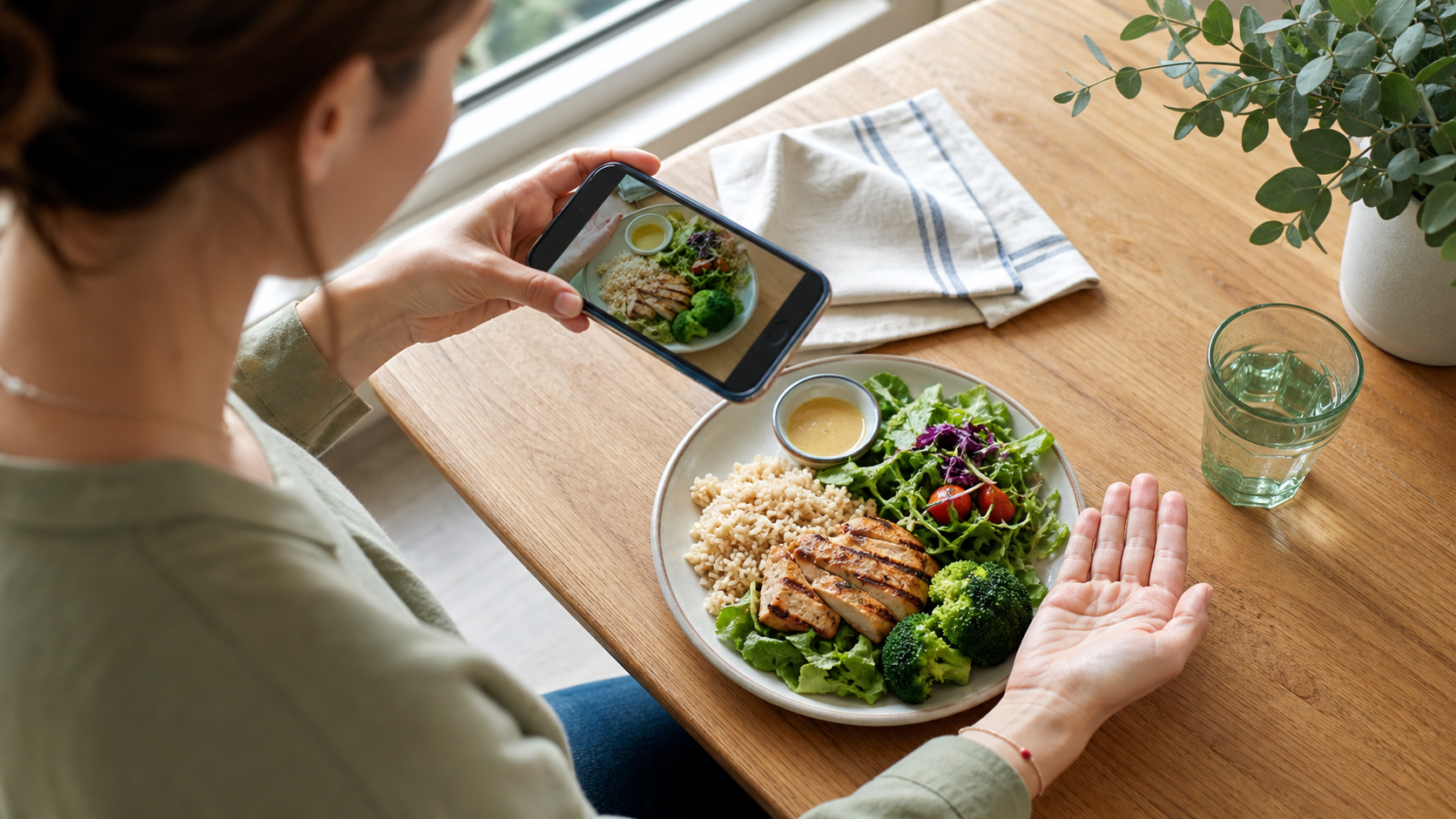
Packaged food has a label. A banana has a standard unit. A homemade bowl can use volume, hand portions, and a photo.
Oil, dressing, sauces, cheese, nuts, nut butter, alcohol, and fried coatings often create more error than leafy vegetables.
A visual estimate is not a lab measurement. Record a sensible midpoint and use several weeks of trends to decide whether the method needs adjustment.
Can calorie tracking without a scale be accurate enough?
It can be useful enough for many general weight-management goals, but “accurate enough” depends on the decision you need to make. If you want to understand whether lunch is roughly 500 or 1,000 calories, visual estimation can be informative. If you need to distinguish 500 from 540 calories, sight alone is unlikely to do that reliably.
Even weighed tracking is not perfectly exact. Nutrition labels allow rounding, restaurant recipes vary, food-composition databases contain different entries, and cooking changes water content. A scale improves portion input; it does not remove every source of uncertainty.
The best no-scale system has three qualities: you can use it consistently, you correct obvious high-impact errors, and you compare the estimate with real-world trends. Research on electronic dietary self-monitoring supports the value of frequent logging, but it should not be interpreted as proof that every approximate entry is correct or that tracking alone guarantees weight loss.
“A bowl with one palm of chicken, about one cup of rice, vegetables, and two spoonfuls of dressing” is more honest and actionable than a highly specific calorie number built on guesses.
Six ways to estimate food without weighing it
1. Use labels and countable units first
Packaged foods give you a serving size, servings per container, and calories per serving. Compare the amount you ate with the label rather than assuming the whole package is one serving. Remember that a label serving is a standardized reference, not a recommendation for how much you personally should eat.
Countable foods are also straightforward: one egg, one slice of bread, one tortilla, one yogurt cup, one medium apple, or one can. Brand and size still matter, but a known unit is usually a better starting point than visual volume.
2. Use your hand as a portable reference
Your hand travels with you and scales loosely with body size, which makes it convenient for relative portioning. A palm can help describe a piece of meat or tofu, a fist can describe a mound of rice or potato, a cupped hand can describe snacks, and a thumb can describe a small amount of spread.
These are categories, not conversions. One palm of salmon and one palm of chicken do not contain the same calories. A loose cupped hand of popcorn and the same volume of nuts are radically different. Use the hand to describe size, then match the correct food in your tracker.
3. Use plate structure for meal balance
A plate with about half fruits and vegetables and the remaining space shared by protein foods and grains or other starches is an easy visual structure. It can support diet quality and portion awareness, but it is not a calorie calculator. The cooking method, sauces, plate diameter, and depth still matter.
For a mixed meal, first picture the components before they were combined. A grain bowl might contain two fists of rice, one palm of protein, several handfuls of vegetables, half an avocado, and dressing. That mental separation makes the estimate more transparent.
4. Learn your own bowls, spoons, and cups
Household dishes can become useful anchors. If your usual cereal bowl holds roughly two cups when level, you can reuse that knowledge without measuring it every morning. The same is true for a soup ladle, coffee mug, serving spoon, or meal-prep container.
Calibrate the vessel once with water or a measuring cup, then remember common fill levels: one-quarter, half, three-quarters, or full. This is usually more reliable than trying to compare food with a tennis ball at every meal.
5. Use familiar object comparisons carefully
Public-health resources sometimes compare portions with familiar objects—for example, a deck of cards for a serving of meat or a tennis ball for a half cup of cooked rice or pasta. These can help when you are learning, but objects vary and three-dimensional portions are difficult to judge. Treat the comparison as a visual prompt, not a guarantee.
6. Start with a meal photo
A photo preserves details that memory loses: the plate size, side dishes, drinks, toppings, and second components. Take the picture from a slight angle so both the surface area and food depth are visible. Include a familiar object such as a fork, standard plate, or your hand for scale.
An AI food scanner can turn the image into a draft log, but it cannot see the oil absorbed during cooking, sugar in a sauce, ingredients under the top layer, or the recipe used by a restaurant. The photo reduces the work of starting; it does not remove the need to review.
Pay extra attention to high-impact foods
Some foods tolerate rough estimates because even a large volume difference changes the total only modestly. Others are energy-dense, so a small visual error can meaningfully change the meal estimate.
| Food or situation | Why it is difficult | Best no-scale clue |
|---|---|---|
| Cooking oil and butter | May be invisible after cooking and easy to underestimate. | Recipe or spoon count Ask how much was used or estimate the share of the batch. |
| Dressing and creamy sauce | Small volumes can add substantial energy. | Container or tablespoons Log separately from the salad or main dish. |
| Nuts, seeds, nut butter | Dense, irregular shapes make handfuls inconsistent. | Count or package Use a single-serve pack or briefly calibrate your usual handful. |
| Cheese and avocado | Thickness and hidden layers are hard to see. | Slices or fraction Record slices, cubes, or a fraction of the whole item. |
| Fried and breaded foods | Absorbed oil and coating vary by preparation. | Matched entry Choose an entry for the correct cooking style, not the plain ingredient. |
| Restaurant mixed dishes | Recipe, oil, sugar, and serving size are unknown. | Range Compare similar restaurant entries and choose a reasonable middle estimate. |
You do not need to become exact about lettuce while ignoring dressing. Spend your attention where it changes the conclusion.
Try a short calibration exercise—without becoming dependent on a scale
If you consistently struggle with one food, measuring it once or twice can teach you more than repeatedly guessing. NIDDK notes that people may measure only long enough to learn typical serving and portion sizes.
- Choose one frequent uncertainty. Rice, cereal, pasta, oil, nuts, or nut butter are common examples.
- Estimate first. Put your normal amount on the plate and write down the portion you think it is.
- Check once. Use a measuring cup, spoon, package division, or scale after making the visual estimate.
- Record the visual cue. Note the fill level in your usual bowl, number of spoonfuls, or size relative to your hand.
- Return to no-scale tracking. Use what you learned for future portions and recalibrate only if the dish or serving style changes.
This is skill-building, not a requirement to weigh indefinitely. If measuring food increases anxiety or compulsive behavior, skip the exercise and use a less detailed method with professional support when needed.
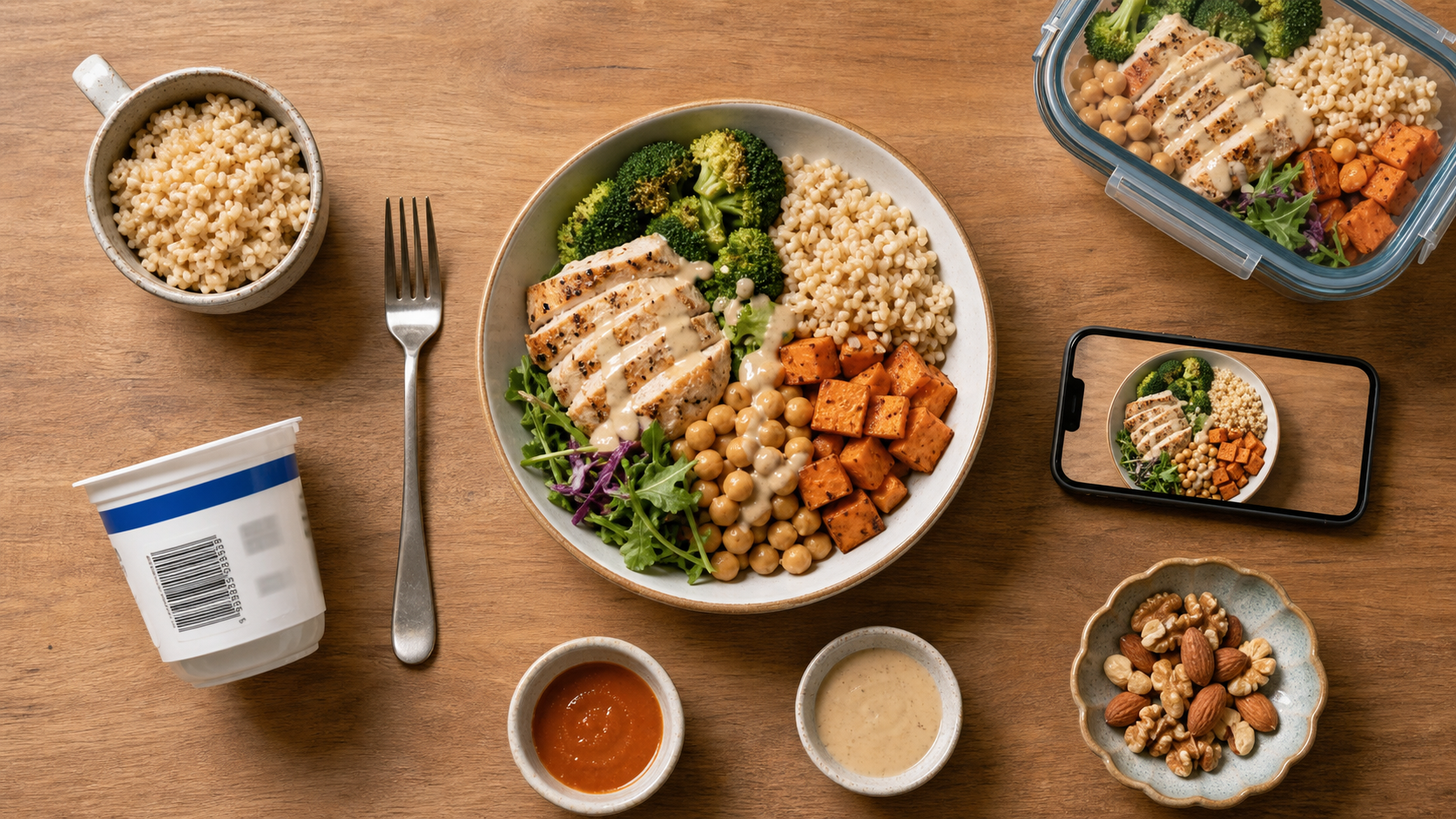
A practical photo-to-log workflow
- Photograph the complete meal. Include drinks, sides, sauces, and toppings. If you have seconds, capture those too.
- List the visible components. Separate protein, grains or starches, vegetables, fruit, fats, sauces, and beverages.
- Choose a portion clue. Use a label, item count, household vessel, hand reference, or a matched database serving.
- Review the high-impact items. Add cooking fat, dressing, cheese, nuts, sweetened drinks, or alcohol separately when relevant.
- Use a range when uncertain. If a restaurant curry might be 600–900 calories, a reasonable midpoint is more defensible than pretending it is exactly 647.
- Save corrected repeats. Once your regular breakfast or lunch is set up, reuse it and edit only what changed.
- Review patterns, not one meal. Compare several weeks of intake, hunger, energy, activity, and body-weight trend if weighing yourself is appropriate.
How to estimate restaurant meals and travel food
Restaurant meals have more uncertainty because you do not control the recipe. Start with any posted nutrition information. If none exists, search for a comparable dish from a similar restaurant rather than a home recipe that may use less oil and a smaller serving.
Split the plate visually and log components when possible. For a burger and fries, record the bun, patty, cheese, sauce, and fries instead of choosing an unrelated generic “restaurant meal.” For curry, stew, casserole, or noodles, use a matched mixed-dish entry and add visible extras.
Travel is a good time to lower the burden. A photo record with rough portions is better than trying to reconstruct several days from memory. Resume your normal method at the next meal; there is no need to compensate for uncertainty with extreme restriction.
How Appediet supports no-scale calorie tracking
Appediet supports a no-scale approach by keeping the meal itself at the center of the log. Photograph the plate from a clear angle, use familiar portion cues to review the draft, and correct only the foods likely to change the estimate meaningfully.
A practical division of labor is simple: use the photo for visible mixed meals, barcode data for packaged foods, and manual entry when you know the recipe or serving. Pay closest attention to oils, spreads, dressings, nuts, cheese, and dense desserts; a small visual difference in these foods can matter more than a larger difference in leafy vegetables.
After correcting a regular breakfast or lunch once, save it and adjust only what changes next time. This turns no-scale tracking into a repeatable estimation system rather than a fresh guessing exercise at every meal.
Limitations: when no-scale tracking is not the right tool
No-scale tracking cannot provide gram-level certainty. Images flatten depth, hands and dishes vary, databases use different recipes, and hidden ingredients remain hidden. AI-generated calorie estimates may look precise even when the inputs are uncertain, so interpret them as estimates.
More exact measurement or professional guidance may be appropriate for medical nutrition therapy, insulin dosing, food allergies where ingredient verification is essential, eating-disorder treatment, athletic weight-class decisions, or another plan prescribed by a qualified clinician or registered dietitian. An app should not replace that care.
If tracking causes escalating anxiety, rigid food rules, bingeing, compensatory exercise, or fear of eating unlogged meals, step back from calorie tracking and speak with a qualified professional. The simplest safe method is better than the most detailed method you cannot use well.
FAQ
Can I track calories accurately without weighing food?
You can create a useful estimate without weighing every food, especially when you use labels for packaged items, consistent visual portions, and a method for checking high-calorie additions. It will not be gram-level precise, so treat the result as a range and review trends over time.
What is the easiest way to estimate calories without a scale?
For many people, the easiest method is to photograph the meal, identify each visible component, estimate portions with familiar units, and correct calorie-dense items such as oils, sauces, nuts, and cheese.
Which foods are hardest to estimate by sight?
Cooking oils, dressings, nut butters, nuts, cheese, alcohol, creamy sauces, fried foods, and mixed dishes are commonly difficult because a small visual difference or hidden ingredient can change the calorie total substantially.
Should I ever weigh food if I prefer no-scale tracking?
You do not need to weigh everything. A short calibration exercise with one or two frequently misjudged foods can teach you what a usual portion looks like. Use label or measured data when tighter accuracy is important.
Can Appediet estimate a meal from a photo?
Appediet can create a photo-based draft with estimated foods and portions. Review and edit the result, especially for hidden ingredients and calorie-dense additions that a camera cannot confirm.
Track the meal you actually ate—without weighing every bite
Use Appediet to scan a meal, review the estimate, correct high-impact details, and save repeat meals for faster everyday tracking.
Download Appediet