
 Appediet
AI Food Scanner vs Manual Calorie Logging
AI food scanning is built for speed and consistency. Manual calorie logging is built for control and precision. The better choice depends on what you are eating, how much accuracy you need, and whether you can keep logging every day.
If you are comparing an AI food scanner with manual calorie logging, the real question is not “which one is perfect?” It is “which one helps me keep a useful food record long enough to make better decisions?”
Manual logging can be highly accurate when foods are weighed, the database entry is correct, and the user has time to enter every ingredient. AI food scanning is less about replacing judgment and more about creating a fast first draft: identify the visible foods, estimate portions, fill the log, and let the user correct the details that matter most.
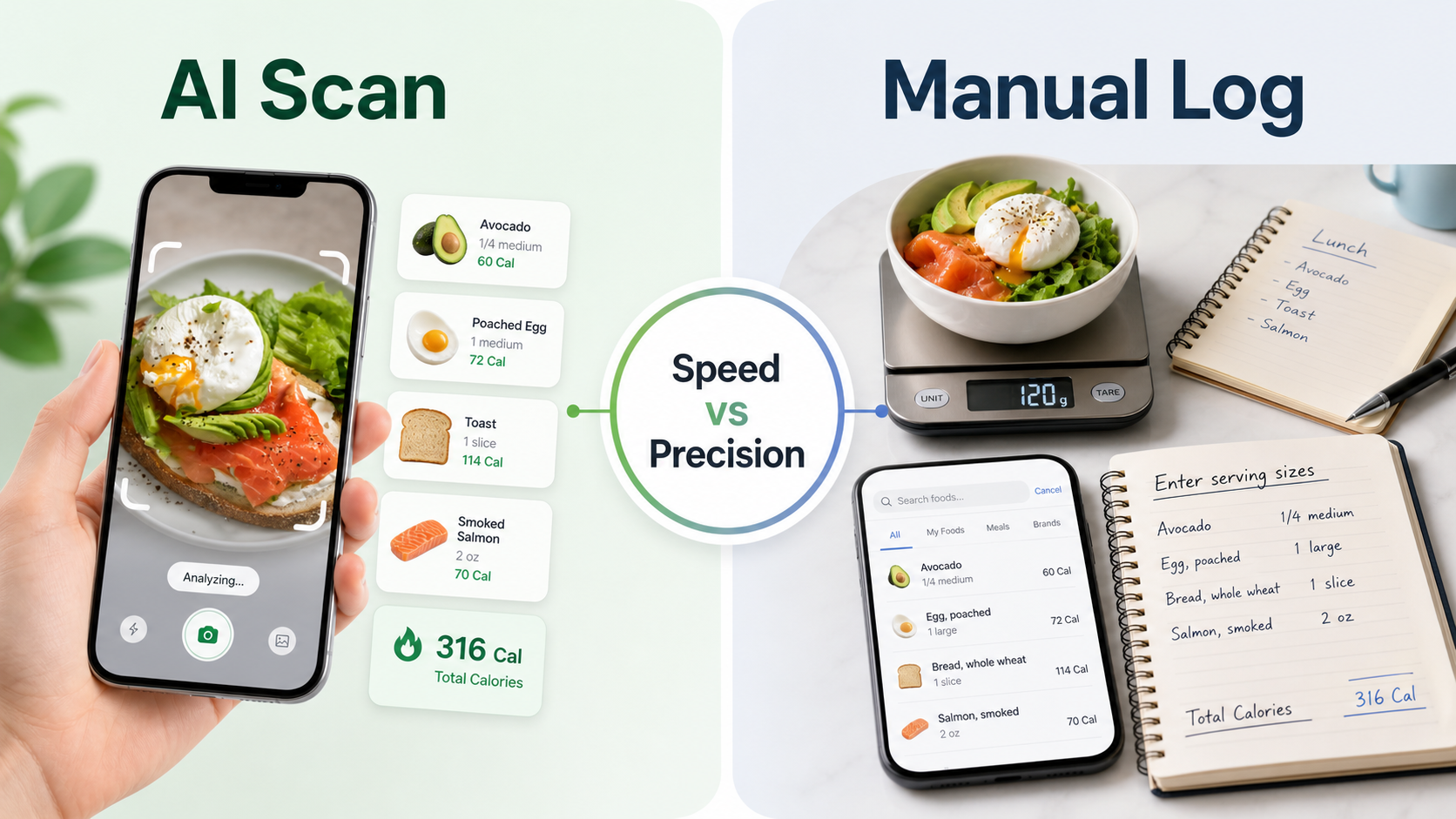
AI scanning is usually faster for mixed plates, restaurant meals, and busy days when typing foods one by one would stop the habit.
Manual logging is usually more precise for weighed ingredients, packaged foods, meal prep, and macro targets that require exact numbers.
Most users benefit from a hybrid method: scan first, then manually adjust high-calorie or uncertain items.
Quick answer: AI scanning is faster; manual logging is more exact
An AI food scanner is usually the better choice when the biggest barrier is effort. If taking a photo helps you log breakfast, lunch, dinner, and snacks more consistently, that extra consistency can be more valuable than chasing perfect entries for only a few meals.
Manual calorie logging is still the better choice when the food is simple, packaged, weighed, or tied to a strict nutrition target. A weighed serving of oats, a barcode-scanned protein bar, or a recipe with known ingredients can be logged more precisely by hand.
Use AI scanning for speed. Use manual edits for precision. The strongest workflow is not fully automatic or fully manual; it is assisted tracking with human correction.
What manual calorie logging actually involves
Manual calorie logging usually sounds simple: search for a food, choose a serving size, and add it to the day. In practice, accurate manual logging requires several decisions for every meal.
- Identify every food and ingredient in the meal.
- Choose a reliable database entry, ideally one with verified nutrition data.
- Estimate or weigh the portion size.
- Enter hidden ingredients such as cooking oil, butter, sauces, dressings, sugar, and toppings.
- Repeat the same process for snacks, drinks, and second servings.
This method can work very well for structured eaters. Meal prep, repeat breakfasts, packaged foods, and weighed ingredients are all strong manual-logging use cases. The downside is friction. The more steps required, the more likely a user is to delay, forget, or stop logging.
What an AI food scanner does differently
An AI food scanner changes the starting point. Instead of asking the user to manually build the meal from scratch, the app starts with a photo and generates a draft log. A good scanner should identify visible foods, estimate portions, produce calories and macros, and make correction easy.
That does not mean the AI “knows” every ingredient with certainty. It cannot always see how much oil was used, whether a sauce contains sugar, or whether a dish was made with low-fat or full-fat ingredients. The value is that it removes the blank page. The user can review and fix the estimate instead of typing everything from zero.
For everyday weight management, this difference matters because many logging failures are behavior failures, not database failures. A slightly imperfect log that exists is often more useful than a perfect log that never gets entered.
Accuracy comparison: where each method wins
Accuracy depends on the meal and the user behavior. Manual logging is not automatically accurate. AI scanning is not automatically inaccurate. Both can be good or poor depending on the inputs.
| Scenario | Better method | Why |
|---|---|---|
| Packaged food with a nutrition label or barcode | Manual | The label gives known calories and macros. Manual or barcode entry is usually more reliable than visual estimation. |
| Home meal with weighed ingredients | Manual | If you know the exact ingredient weights, manual recipe logging can be highly precise. |
| Restaurant plate or cafeteria meal | AI scan | The exact recipe is unknown. A photo-based estimate can be faster than guessing every item from memory. |
| Mixed plate with visible foods | AI + edit | AI can identify the main foods quickly; the user should adjust dense items such as oils, sauces, cheese, and nuts. |
| Strict macro target, athletic prep, or medical nutrition plan | Manual | These use cases need tighter control and should not rely only on a visual estimate. |
The biggest mistake is treating either method as magic. A manual entry can be wrong if the serving size is wrong. A scanner can be wrong if the food is hidden, overlapped, poorly lit, or visually ambiguous. The best tracking system makes uncertainty visible and easy to correct.
Effort and consistency matter as much as precision
Dietary self-monitoring research has repeatedly pointed to the importance of adherence: people who record intake more consistently tend to have better visibility into their eating patterns. That does not mean logging alone causes success, but it does explain why low-friction tools can matter.
Manual logging often fails at the moment of inconvenience. A user may know how to log carefully, but still skip dinner because the meal has too many ingredients. AI scanning helps in exactly that moment. It lets the user capture something useful quickly, then improve the details later if needed.
For readers comparing “AI food scanner vs manual logging,” this is the practical tradeoff: manual logging optimizes individual-entry precision; AI scanning optimizes habit continuity. The best tool is the one that supports the user’s real behavior, not an ideal behavior that only happens on perfect days.
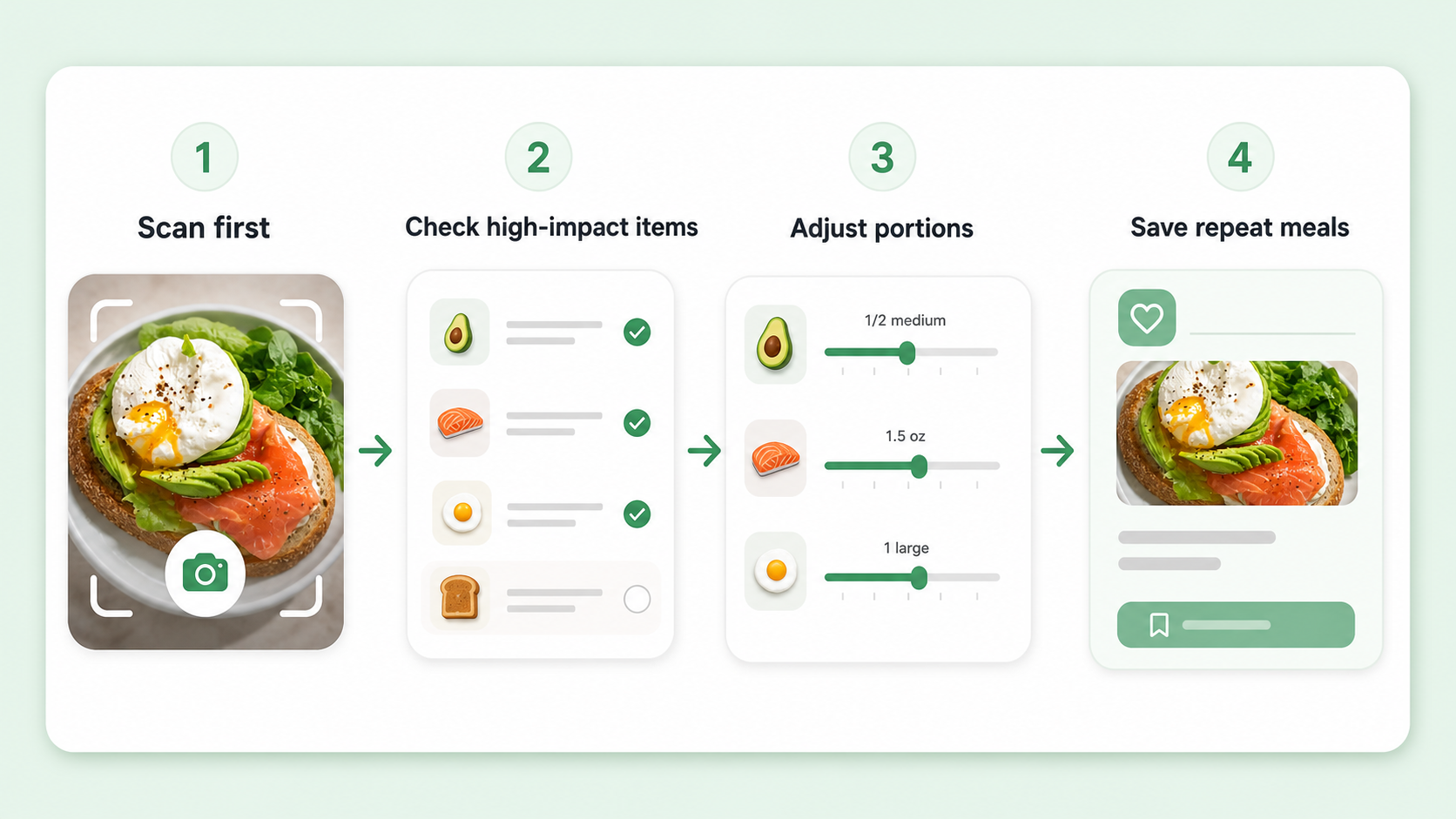
The best workflow: scan first, correct what matters
A practical hybrid workflow is simple enough to use daily and careful enough to avoid the most common calorie-tracking errors.
- Take a clear photo before eating. Good lighting and visible food separation improve the starting estimate.
- Review the detected foods. Confirm that the main items are correct. If chicken was recognized as fish, fix it immediately.
- Adjust calorie-dense items. Prioritize oil, butter, sauces, dressings, nuts, cheese, avocado, desserts, and sugary drinks because small portion differences can change the total significantly.
- Use barcode or manual entry when better. Packaged foods should use label data when available.
- Save repeat meals. If you eat the same breakfast or lunch often, save the corrected version so the next log is faster and more consistent.
This workflow avoids the two extremes: blindly trusting the AI or forcing the user to do everything manually. It gives the user speed where speed matters and precision where precision matters.
How Appediet supports AI scanning and manual control
Appediet is built for the point where speed and control meet. A meal photo creates the first draft; the user decides which details deserve a closer look. That makes the camera useful without treating recognition as the final answer.
- Scan the visible plate. Start with the foods the camera can reasonably identify instead of rebuilding the meal from an empty search field.
- Audit the high-impact details. Check portions, cooking oil, dressings, cheese, nuts, sauces, and other calorie-dense additions that a photo cannot reliably measure.
- Use the strongest input for each food. Keep the photo estimate for a mixed plate, switch to barcode data for packaged food, or enter a known amount manually.
Once a corrected meal reflects what you actually ate, saving it turns future logging into retrieval rather than repeated estimation. The advantage is not automation alone; it is a shorter path from an imperfect first draft to a log you understand.
Limitations to understand before using any calorie tracker
No calorie tracking method is perfect. Nutrition databases vary. Restaurant recipes vary. Home cooking varies. Human portion estimates vary. AI vision also has limits when foods are covered, blended, stacked, or hidden inside sauces and baked dishes.
The right expectation is directional accuracy. A tracker should help you see patterns: whether your breakfast is protein-light, whether snacks are adding more calories than expected, whether weekend meals differ from weekdays, or whether portion sizes are drifting upward.
The goal is not to turn every meal into a math test. The goal is to build enough awareness to make better decisions consistently.
Which method should you choose?
Choose manual calorie logging if you already have a structured routine, eat many packaged or weighed foods, or need exact macro control. Choose AI food scanning if speed, convenience, and consistency are your biggest barriers.
Choose a hybrid app like Appediet if you want both: fast photo capture for real life, with manual correction when the details matter.
FAQ
Is an AI food scanner more accurate than manual calorie logging?
Not always. Manual logging can be more precise when food is weighed and the nutrition entry is correct. AI scanning is often better for speed and consistency, especially when the alternative is skipping the log.
When should I still log manually?
Log manually for packaged foods, weighed ingredients, repeat recipes, strict macro targets, or nutrition plans guided by a health professional.
Can I scan first and then edit the result?
Yes. That is usually the best workflow. Scan the meal, then edit foods, portions, or high-calorie additions that the image may not capture accurately.
Does AI scanning work for homemade meals?
It works best when major components are visible. For stews, casseroles, blended foods, or recipes with hidden ingredients, manual adjustment is important.
Is Appediet a medical nutrition tool?
No. Appediet is a nutrition tracking and awareness tool. For medical nutrition therapy or disease-specific diet advice, work with a qualified clinician or registered dietitian.
Track meals faster without giving up control
Use Appediet to scan meals, review the estimate, adjust portions, and save repeat meals for easier daily tracking.
Download Appediet